Showing posts with label eating local. Show all posts

Wednesday, November 17, 2010

Homegrown

I worked as a gardener back when we lived in the city - but aside from small herb gardens and container cherry tomatoes, I never really had the opportunity to grow any food. Last Winter, I wrote in an early post about all the seeds we had ordered for our very first vegetable garden. It almost seemed like a dream at that time, with snow on the ground and a fire in the wood stove.

With the help of some very helpful books, we planned and "designed" our gardens and got to work starting seedlings indoors. It was difficult to find enough window space with adequate sunlight to get these little plants going. I had to bring tables up into the guest rooms to accommodate the many flats we had set up.


The seeds that were started indoors were leeks, tomatoes, peppers, spinach, thyme, rosemary, lavender, basil, broccoli and potatoes. Every morning, I spent about an hour spritzing the small pots with water and checking on the little seedlings' progress. Some seeds sprouted, some did not. Some seedlings survived, and some did not, but all in all, it was an exciting success!

Springtime came along and it was time to dig out the garden plots. This is where the real work began. Without any machinery, we had to remove all the sod by hand. What a thankless job. You get absolutely filthy trying to shake most of the dirt out of the grass roots and then you get stuck with all this heavy plant material that you have to dispose of. We also had to hand-till all this bare soil. We de-sodded and tilled just under 1,000 square feet of garden space. Beatrice and Charlotte kept me company and got paid in earthworms.


April came along and it was time to put some of our seedlings into the ground and plant some onion sets. The first salad greens were such a sight for sore eyes! What a delight... Our first salad consisted of lettuce, chives and radishes and I don't think I've ever tasted anything so fresh.


The garden grew and grew and we enjoyed the fruits of our labour. Stuart and I were in a constant marvel at the wondrous taste of the vegetables we grew. It is just incomparable to the taste of grocery-store bought veggies. We would often just walk by the garden and pick a spinach leaf and eat it right there on our path... the pure taste of the water of life (with a bit of dirt). 

Of course, there were some successes but also some failures. Despite being under the impression that I had used correct spacing between plants, the garden grew some more and became quite crowded!

One interesting experiment was trying to grow food completely naturally - no pesticides or any chemicals (organic or not). This of course led to some unwanted pests, but I told myself that there was enough for everyone and that these little guys were also the foodstuff of some other, welcome visitors. So our lettuce had holes in it. The cabbage didn't do too well despite my efforts at handpicking those horrible green cabbage worms (which I would bring over to the chickens as treats). It never really recovered from the infestation and ended up looking like lace. Our potatoes were not perfect but they were delicious. The tomatillos and ground cherries got eaten a bit by flea beetles, but they made it and bore wonderful fruit. On a particularly flea beetle busy week, I did concoct a mixture of onion juice, garlic juice, cayenne pepper and natural dish soap to spray some vulnerable plants but that's as far as I got in terms of pest management. 

What hit our garden the worse were the incessant thunderstorms that plagued our Summer. The 6-foot tall tomato plants got flattened more times than I care to remember. Our cucumber plants grew to satisfyingly monstrous proportions, baring hundreds of fruit-producing flowers only to be attacked by some sort of fungus just as the fruit were starting to grow. The disease killed the plants in just about a week and I only got to make two jars of pickles.

The goal of growing all this stuff was partly to enjoy it during the Summer, and partly to help us along in our attempt at a more independent, sustainable way of life. The idea was to grow enough vegetables to sustain us over the Winter. Well, I did expect that there would be pitfalls and that it would take a few years to figure out exactly how much of each veggie we consume and have to grow to reach this goal. We did quite well with the tomatoes, but we didn't grow nearly enough root and winter storage vegetables. We didn't even get to building a root cellar this Fall because aside from a few small squash (not enough compost), about 50 carrots and a few onions, we have nothing really to put in it.


When you grow more food than you can consume before it goes bad, you have to learn ways to preserve it for later use. This is where my new-found love comes in: Canning. I love canning. It kind of makes me understand how a squirrel feels, putting food away for the coming Winter. It gives me such a warm feeling inside. When we're all snowed-in, all we'll have to do is open the cupboard door and pull out a jar of crunchy dilly beans, close our eyes and be taken back to the fresh taste of Summer!


My friend Terri, who is a wonderful cook, taught me how to can. It's great to have someone to talk to and have a drink with while you spend hours chopping and dicing vegetables for relishes! I also bought a few books with recipes and got to work, making a cornucopia of canned goods: sauces (hot pepper, spicy plum, cranberry ketchup, peach and tomato ketchup), hot pepper jellies, pickles (cucumber, baby carrot, beans, onions), relishes (corn, zucchini, swiss chard), chutneys (rhubarb, peach), jams (blueberry, peach, raspberry, strawberry, blackberry), salsas (tomatillo, pear and pepper), conserves (peach, rhubarb in honey syrup, blackberries in red wine)...

I also made soups and pestos with roots, squash and leafy greens for the freezer, and froze piles of produce for later use.

The garden has now been cleaned-out and leftovers have been given to the chooks. The soil has been tilled with  manure and old straw and turned over for the Winter. The garlic bulbs have been planted. And I am waiting for our first snow, thinking about next year's garden delights.


Tuesday, October 26, 2010

Our First Summer on the Farm: CHICKENS

My last post dates from all the way back in March, as we tapped our Maple and made our first batch of glorious maple syrup. 

It's been a busy Summer here at Hillcrest Farm.  We've learned a lot about vegetable gardening and its related joys and pittfalls. We've had some births and some deaths. We've had a lot of lovely guests and some unwanted pests. And finally we come full-circle: we've now spent one entire year on the farm.

It's Fall now and our Maple stands proud but naked again.

CHICKENS

One of the most exciting experiences we've had this Summer has been that of raising chickens for meat and to add to our layer flock.


We ordered twenty-eight day-old chicks from Frey's Hatchery. The wee Plymouth Barred Rock birds arrived at the local Feed & Seed store on April 14, tightly packed in a tiny cardboard box that looked like Chinese take-out.


The  little ones were just so sweet that it was difficult to imagine that we'd be eating them in a short while. We tried not to think about it. We made our very first brooder box out of an old bathtub which we set up in a separate pen of the chicken coop.


As Summer arrived, the little ones grew into beautiful teenage chicks and we allowed them to join the general population (consisting of two Red Sex Link hens and our little banty rooster, Stuster). We sent them all outside to play in the grass and catch flies and mosquitoes.


We arranged for them to have a jungle gym so they could grow into healthy, happy chickens, which they did.


Out of the twenty-eight chicks, three roosters came out. One of them matured before the other two. He was so glamourous and gorgeous that we initially decided to keep him for breeding next year's batch of chicks. We named him Clarence. He kept himself very busy with the gals.


Maybe a bit too busy. Clarence quickly earned the nickname "You Sexy Beast". He became extremely aggressive. The girls were constantly running away from him and fighting him off. He even started challenging me when I entered the barnyard, puffing himself up and darting at me - even as I challenged him back. One morning, he figured out that he was four times bigger than our beloved Stuster, our very small pet rooster, and beat his face into the ground - nearly killing him (our little Stuster never fully recovered from this attack and became ill and died shortly after despite all our efforts to make him better). Clarence became more than we wanted to handle and we decided his time had come.


Clarence was served up in a beautiful soup that night for dinner, with some dumplings. It was sad to see this splendid bird go. He was very delicious, however.

Of our remaining twenty-seven Barred Rocks, we traded four hens and a rooster for a deep freezer. Summer came and left and it was suddenly Fall. We needed to start butchering our feathery friends and place them in our new freezer.


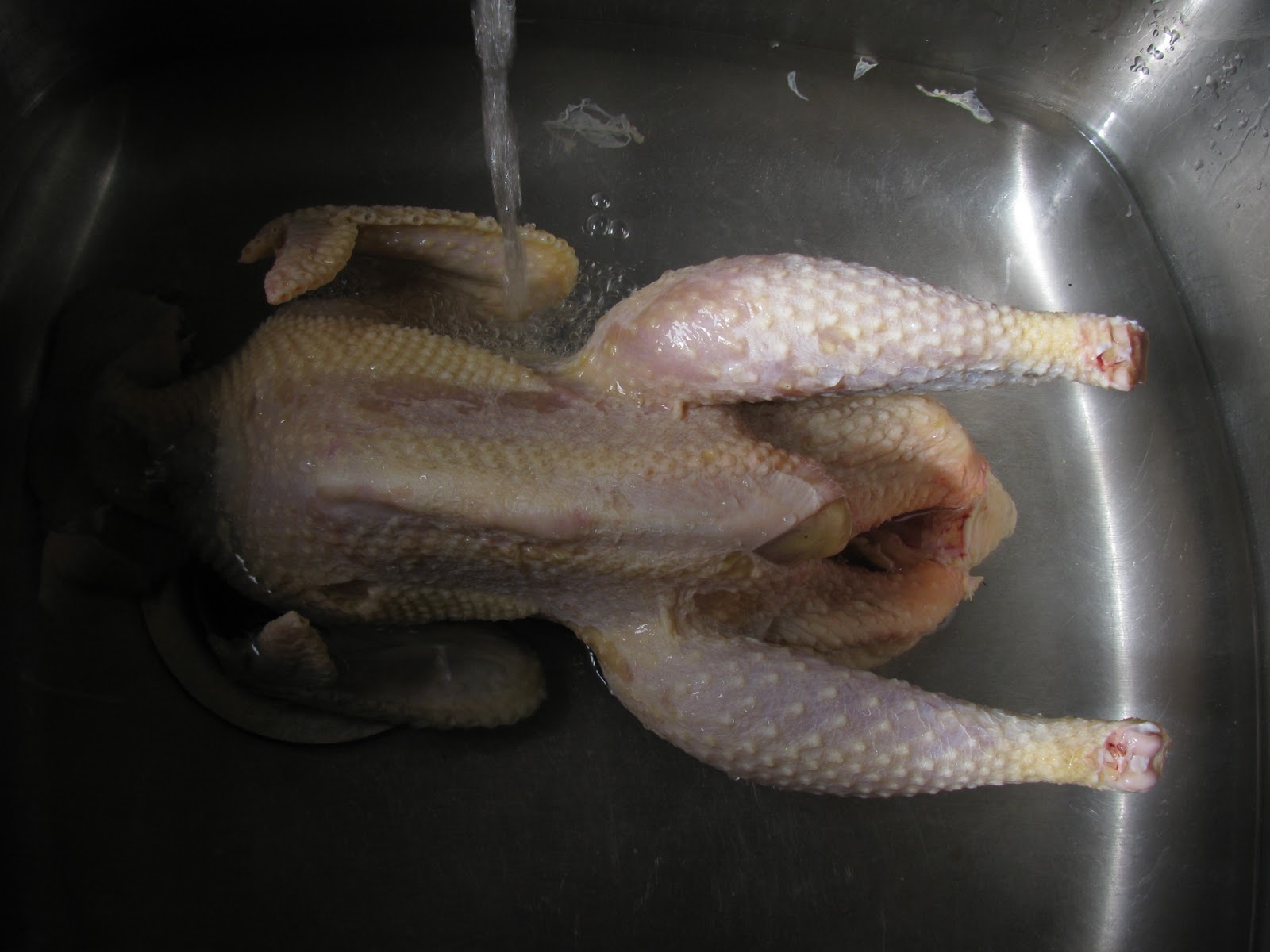
It's not easy killing your friends. But such is life on the farm. You feed your animals and in turn, they get to feed you. Catching a chicken is not easy either. Physically or emotionally. You've got to really get in "the zone" and come to terms with the fact that this was your purpose from the very start, even as you first picked them up in their little Chinese take-out home. After catching the chicken, I like to make a little prayer of gratitude and then thank the bird for its generous gift before I hand it over to Stuart for the killing. I've killed once and decided that it was enough for me. It's now a "man job". I get to catch, pluck, clean and cook. I'm fine with that.

It's amazing what you find inside a chicken:


Every egg that chicken was ever going to lay is already formed inside its belly and you get to pull them all out. From a fully-formed, ready-to-lay egg with shell to a large, shell-less yolk to a medium one, a small one and loads of itty bitty ones, some even too small for the naked eye to see.

We meant to perform the slaughter in one day but due to inexperience, we've had to extend it over many following Saturdays. Seven is the most we've been able to do in one day. I guess we're not very thick-skinned in that department yet. It  is a daunting and exhausting task. I've come to the conclusion that maybe that's the way it's supposed to be. 

When I lived in the city I often wondered whether I should become a vegetarian when looking at the meat counter in the grocery store. Where do these animals come from? How have they been raised? How did they live? How did they die? I never knew. My conclusion was always that I love to eat meat and could never do without. I put my head in the sand and purchased another piece of mystery meat, neatly packaged in plastic and Styrofoam and absorbent napkins.

This new experience of raising our own meat allows me to be more comfortable with my eating choice, but most importantly, more uncomfortable with it. My conclusion is that maybe it's not meant to be so easy to eat meat. It's not at all easy for other carnivorous animals: they have to go hungry and chase and hunt and kill and succeed and fail. The process is not the same for us, but perhaps I'm supposed to look death right in the face and know EXACTLY what it is that I am eating. It tastes a lot better in the end, as strange as it seems.

Our raising meat has been fraught with successes and failures. Our chickens are a little bit skinny. Their meat is a little bit tough. We've learned our lessons and hope to make different choices in terms of breed and feed in the years ahead, but we now find ourselves changed and humbled by the food that will feed us throughout the winter.